Labour Codes in India: Important Legal Clarifications Every Employee and Employer Should Understand in 2026
Introduction India’s Labour Codes continue to remain one of the most discussed and debated legal reforms affecting employees, employers, HR professionals, trade unions, start-ups, IT companies, manufacturing establishments, and service-sector organizations across the country. Since the introduction of the four Labour Codes, there has been widespread confusion regarding the revised wage structure, gratuity eligibility, overtime…

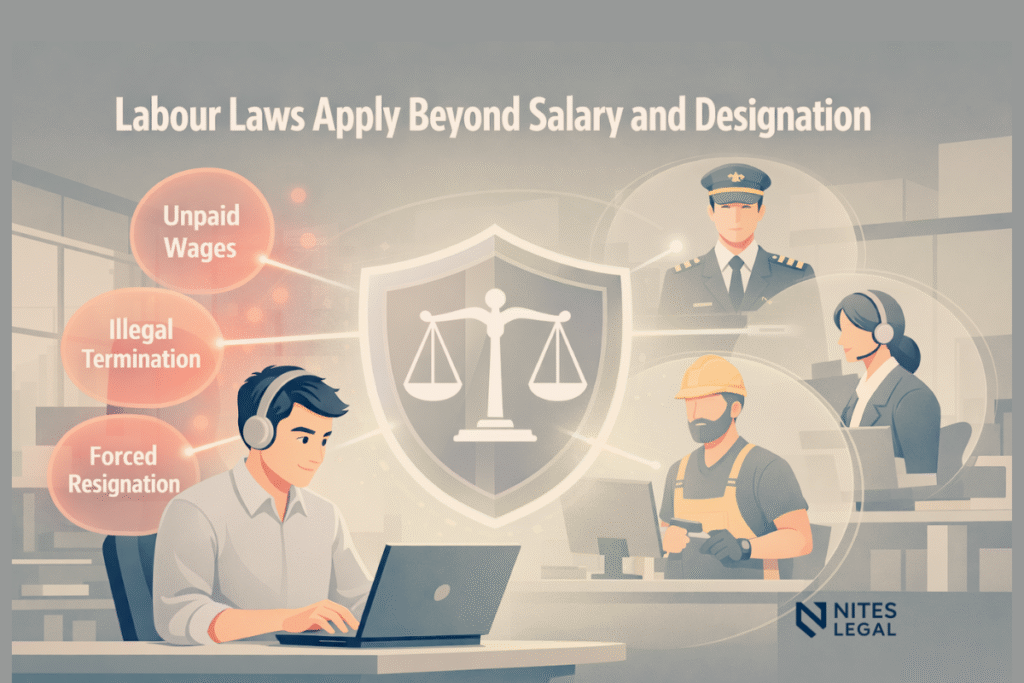
High Salary Does Not Exclude Employees from Labour Laws: Delhi High Court on Workman Status
A recent judgment of the Delhi High Court has provided important clarity on the scope of labour law protections and has direct relevance for employees in the IT and technology sector. In King Airways vs Captain Pritam Singh, along with connected matters, the Delhi High Court was dealing with long pending disputes between King Airways…
OSHWC Code, 2020: New Standards for Workplace Safety
The Occupational Safety, Health and Working Conditions Code, 2020 is the most wide-ranging of the four labour codes because it brings together thirteen different laws relating to workplace safety, health, working hours, welfare facilities, contract labour and registration of establishments. The earlier framework was spread across multiple Acts, each with its own definitions and compliance…
Code on Social Security, 2020: Expanded Worker Benefits
The Code on Social Security, 2020 brings together nine separate laws into one consolidated framework. It aims to universalise social protection so that every worker, regardless of the sector or type of employment, receives access to essential benefits. The earlier system was scattered across different Acts governing provident fund, insurance, maternity benefits, gratuity and compensation.…
Industrial Relations Code, 2020: New Rules for Employment
The Industrial Relations Code, 2020 reshapes the way India governs employment conditions, job security, dispute resolution and trade union rights. It consolidates three major laws into one comprehensive framework and creates a uniform system that applies across the country. For workers and organisations, this Code influences how disputes are raised, how employment terms are managed,…
The Code on Wages, 2019: What Changes for Employees
The Code on Wages, 2019 is now in force, replacing four earlier laws that governed wages and bonus for several decades. It brings all workers under a single wage framework, introduces uniform definitions and creates clarity around minimum wages, payment timelines and authorised deductions. For the first time, employees across every sector come under a…
Rewriting Work in India: Understanding the Newly Implemented Labour Codes
India has entered a defining moment in its labour history with the implementation of the four labour codes that replace 29 separate laws which governed the rights, wages and safety of workers for decades. For a long time, employees and employers have operated within a system that was fragmented, often confusing and not aligned with…
DPDP Rules 2025 – India’s Biggest Shift in Data Protection
The Government of India has formally notified the Digital Personal Data Protection Rules 2025, bringing the long-delayed data protection framework into full implementation. Although the Digital Personal Data Protection Act was enacted in August 2023, its enforcement remained incomplete without the supporting rules. With the notification issued on 13 November 2025, India now enters a…
AI in Indian Workplaces: Balancing Innovation and Fairness
Seeing the People Behind the Algorithms Artificial Intelligence is no longer a distant idea; it is part of everyday life in India’s tech and service sectors. From large corporations using AI to sift through thousands of job applications to teams tracking productivity through digital dashboards, today’s workforce operates under the increasing influence of algorithms. Yet…

Delhi High Court Directs Reconsideration in Air India Pay Parity Case
The Delhi High Court’s recent judgment in the case involving the Airport Employees Union and Air India has brought clarity and renewed judicial focus on the complex issue of pay parity claims by contract workers. This matter concerns more than 180 contract laborers engaged through a contractor to handle baggage and cargo at Indira Gandhi…
When Family Feuds Enter Boardrooms: Supreme Court Protects Shareholder Rights.
When Family Feuds Enter Boardrooms: Supreme Court Protects Shareholder Rights. On 2nd September 2025, the Supreme Court of India delivered a significant judgment in Mrs. Shailja Krishna vs. Satori Global Limited & Ors. (Civil Appeal Nos. 6377–6378 of 2023), which will have far-reaching implications on the law relating to oppression and mismanagement, fraudulent share transfers,…
When Can Employers Forfeit Your Gratuity?
When Can Employers Forfeit Your Gratuity? Calcutta High Court Sets the Record Straight As someone who has spent considerable time dealing with employment disputes, I’ve seen countless cases where employers attempt to withhold gratuity payments citing employee misconduct. The recent judgment by Justice Shampa Dutt (Paul) of the Calcutta High Court in M/s. Xpro India…
The Promotion and Regulation of Online Gaming Bill, 2025: A New Era for India’s Digital Economy
On 21st August 2025, the Parliament of India passed the Promotion and Regulation of Online Gaming Bill, 2025—a legislation that marks one of the most significant regulatory interventions in India’s digital journey. The law seeks to strike a balance between curbing the dangers of unregulated online money gaming and fostering the immense potential of e-sports, social gaming,…
Supreme Court’s Landmark Ruling on Disciplinary Proceedings: A Turning Point for Fairness and Compliance
Introduction The Supreme Court of India has recently delivered a judgment that reshapes the way disciplinary proceedings are to be understood and conducted in the country. In K. Prabhakar Hegde v. Bank of Baroda (Civil Appeal No. 6599 of 2025, decided on 19 August 2025), the Court reaffirmed the idea that disciplinary inquiries are not…